Home Menu

Site Navigation


Notices

Serious Debates & News Debate and discussion about political, moral, philosophical, celebrity and news topics.

Register to reply Log in to reply
 
Thread Tools Search this Thread Display Modes
Old 08-02-2026, 08:27 AM #1
arista's Avatar
arista arista is online now
Senior Member
 
Join Date: May 2006
Posts: 190,683
arista arista is online now
Senior Member
arista's Avatar
 
Join Date: May 2006
Posts: 190,683
Default Japan Snap Election Today :Sanae Takaichi

Sky News brought up


[Sanae Takaichi, who became Japan's
first female prime minister in October 2025,
is a staunch conservative who
openly opposes same-sex marriage,
aligning with her support for traditional family
structures and values
. As a prominent member of the
Liberal Democratic Party (LDP), she also opposes
allowing married couples to
have separate surnames.]


Her attacks on China
concern some in Japan.


[Japanese people are braving the snow to vote
in a snap election called by
Prime Minister Sanae Takaichi,
whose coalition is predicted to clinch a decisive win.

Takaichi called the country's first mid-winter poll
in 36 years to seek a public mandate soon after
winning her party's leadership race last October.]


[Japanese voters have been frustrated with the
recent political scandals in the LDP,
especially as costs soared.

"Housing is very expensive," says Rumi Hayama.
"Our son is getting bigger and we need
a bigger place but it is not affordable
although we have decent jobs.
Prices are getting higher and [it is] getting hard to
live in Japan. It was not like this before."]
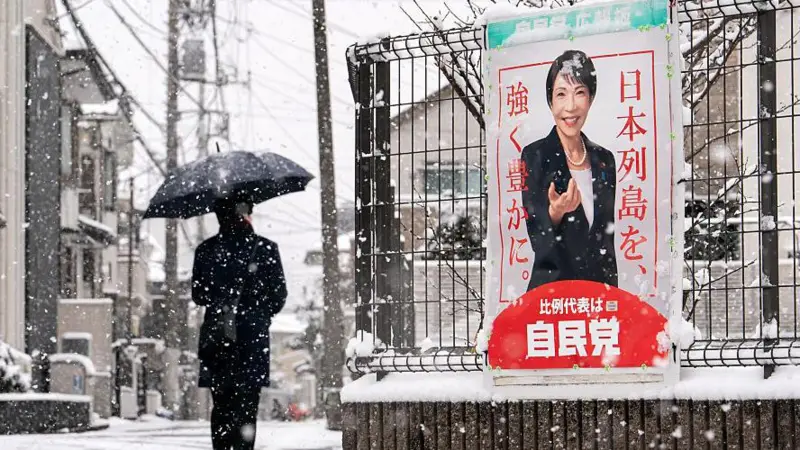


She is a Former Drummer


https://ichef.bbci.co.uk/ace/standar...512f6.jpg.webp

Last edited by arista; 08-02-2026 at 08:29 AM.
arista is online now  
Old 08-02-2026, 11:25 PM #2
arista's Avatar
arista arista is online now
Senior Member
 
Join Date: May 2006
Posts: 190,683
arista arista is online now
Senior Member
arista's Avatar
 
Join Date: May 2006
Posts: 190,683
Default

She won, again.

arista is online now  
Old 08-02-2026, 11:41 PM #3
Maru's Avatar
Maru Maru is offline
All the crayons
 
Join Date: Sep 2015
Location: Houston, TX USA
Posts: 13,239

Favourites (more):
BB2023: Jordan
CBB22: Gabby Allen


Maru Maru is offline
All the crayons
Maru's Avatar
 
Join Date: Sep 2015
Location: Houston, TX USA
Posts: 13,239

Favourites (more):
BB2023: Jordan
CBB22: Gabby Allen


Default

Huge majority
__________________
Maru is offline  
Old Yesterday, 12:08 AM #4
Maru's Avatar
Maru Maru is offline
All the crayons
 
Join Date: Sep 2015
Location: Houston, TX USA
Posts: 13,239

Favourites (more):
BB2023: Jordan
CBB22: Gabby Allen


Maru Maru is offline
All the crayons
Maru's Avatar
 
Join Date: Sep 2015
Location: Houston, TX USA
Posts: 13,239

Favourites (more):
BB2023: Jordan
CBB22: Gabby Allen


Default


Mainichi article about the win.

*Ignore any gender swapping in the translations, the Japanese language isn't as obsessed with pronouns as Westerners are so it'll infer the gender (*gasp*) in machine translations:

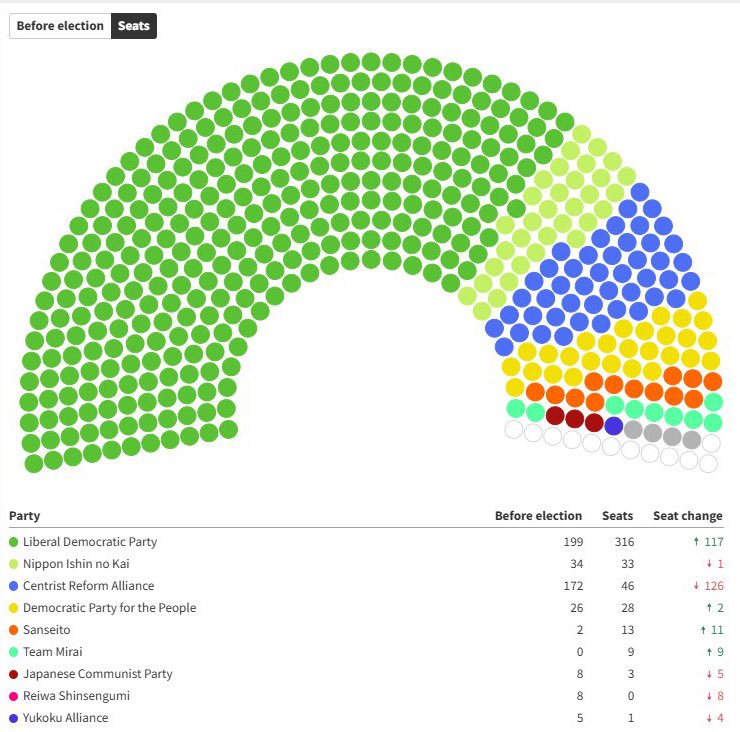
LDP alone wins two-thirds majority. Takaichi's popularity secures 310 seats, the highest since the war. Center parties suffer crushing defeat, losing 70% of their seats.
S: https://mainichi.jp/articles/2026020...0m/010/064000c
Google translate: https://mainichi-jp.translate.goog/a..._x_tr_pto=wapp

Quote:
The 51st House of Representatives election was held on the 8th, and of the 465 seats (289 single-seat districts, 176 proportional representation), the Liberal Democratic Party far surpassed the single-seat majority line (233 seats), exceeding the two-thirds majority (310 seats) required to repass a bill even if it is rejected in the House of Councillors, where the ruling party is a minority. This is the first time since the war that a single party has secured two-thirds of the seats. It monopolized single-seat district seats in 31 prefectures. Meanwhile, the new party "Centre Reform Alliance," formed by the Constitutional Democratic Party of Japan and the Komeito Party, suffered a devastating defeat, with its 167 seats before the election announcement expected to fall by approximately 70%.

 Prime Minister Sanae Takaichi (President of the Liberal Democratic Party) is expected to be re-elected at the special Diet session scheduled to be convened in mid-February, and a second Takaichi Cabinet is expected to be formed.

 The LDP increased its seats by more than 100 from the 198 seats it held before the election, significantly surpassing the winning line set by the prime minister for a majority as a ruling party. This historic victory surpasses the previous record of 308 seats won by a single party in the postwar House of Representatives election, when the former Democratic Party took power in 2009.

 On a television program on the evening of the 8th, the Prime Minister stated, "I will certainly fulfill my campaign promises." Regarding his own proposal to eliminate consumption tax on food and beverages for two years, he pointed out, "We will accelerate our deliberations at a (bipartisan) national conference." He added, "Each party has a variety of opinions. If we can reach a conclusion quickly, we will submit a tax law reform bill." Regarding the appointment of ministers for his second cabinet, he said, "It's only been a little over three months (since the inauguration of the government). We are already producing results, so I'm not considering changing this." However, he also said, "As an exception, if there is talk of sending one member of the Japan Restoration Party to the cabinet, I would consider it," signaling his desire for cooperation from the Japan Restoration Party within the cabinet.

 The LDP was able to take advantage of the high approval ratings of the Cabinet and advance in the race. In addition to Gunma, Toyama, Yamaguchi, and other prefectures where the LDP boasts solid support bases, it also dominated seats in Miyagi, Nagano, Shizuoka, Shiga, and other prefectures where the opposition parties also won seats in the last election. Furthermore, on the 8th, the LDP announced that it had officially endorsed Takeshi Saiki, an independent former incumbent who is certain to win in Fukui's 2nd district.

 The LDP suffered major defeats in the October 2012 House of Representatives election and the July 2013 House of Councillors election, leaving the Diet in a precarious state. This time, the LDP monopolized the chairperson posts in 17 standing committees in the House of Representatives, and secured an "absolute stable majority" (261 seats) that holds a majority in each committee, allowing for smooth deliberations on bills and other matters. The LDP now holds a further two-thirds majority. Not only can bills be passed again in the House of Representatives, but the LDP alone will hold the seats needed to propose constitutional amendments in the Diet.

 The Center Party advocated for moderate politics that leaned neither conservatively nor progressively, aiming to be a counterweight to the strongly conservative Takaichi administration. However, in an election campaign shortly after its formation, it faced the challenge of reaching out to voters. Even in the final stages of the campaign, when the party attempted to make a comeback, it lacked momentum, and in the Tohoku region, where the Constitutional Democratic Party had performed well in the last election, it was defeated by LDP candidates in most electoral districts, making it a tough battle.

 Although the Ishin Party lacked widespread support outside of its base in Osaka, it still managed to secure 34 seats, which was the number it had before the election announcement. The Democratic Party for the People secured 27 seats, which was the number it had before the election announcement. The Communist Party fell short of the eight seats it had before the election announcement. Reiwa Shinsengumi also lacked momentum and is likely to fall far short of the eight seats it had before the election announcement. The Sansei Party and Team Mirai increased their support in the proportional representation system, with Sansei winning over 10 seats and Mirai winning 10 seats. [Kaite Yusuke]
__________________

Last edited by Maru; Yesterday at 12:43 AM.
Maru is offline  
Old Yesterday, 12:26 AM #5
Maru's Avatar
Maru Maru is offline
All the crayons
 
Join Date: Sep 2015
Location: Houston, TX USA
Posts: 13,239

Favourites (more):
BB2023: Jordan
CBB22: Gabby Allen


Maru Maru is offline
All the crayons
Maru's Avatar
 
Join Date: Sep 2015
Location: Houston, TX USA
Posts: 13,239

Favourites (more):
BB2023: Jordan
CBB22: Gabby Allen


Default

This guy didn't win though. I believe Conservative Party is supposed to be Reform UK-ish, aka "Japan First":

Posting for video:


S: https://mainichi.jp/articles/2026020...0m/010/297000c
Google translate: https://mainichi-jp.translate.goog/a..._x_tr_pto=wapp

Quote:
Conservative Party fails to win seats in House of Representatives; Naoki Hyakuta and others form new party; internal conflict abounds

The Japanese Conservative Party failed to win any seats in the House of Representatives election held on the 8th.

 The Japanese Conservative Party was founded in 2023 by author Naoki Hyakuta and others. It won three seats in the 2024 House of Representatives election and received more than 2% of the proportional representation vote, fulfilling the requirements to be a political party. In the 2025 House of Councillors election, Hyakuta and two other members were elected.

 Meanwhile, due to conflicts over party management, Takashi Kawamura and two others submitted their resignations from the party, and the party expelled them in January of this year.
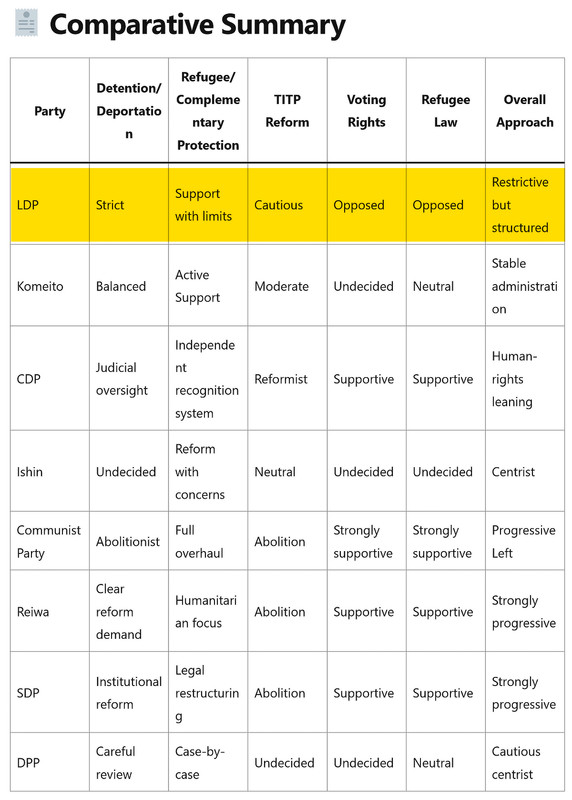
Party differences per immigration issue:

Overview on the stance of each political party in Japan regarding current immigration and refugee policies
S: https://www.japan-workers.com/?p=1210

Key differences:


Quote:
*Liberal Democratic Party (LDP)
  • Basic Stance: Strict Enforcement Against Illegal or Fraudulent Stays
    The LDP advocates a strong response to illegal or fraudulent stays, including stricter handling of forged residence cards and improved deportation processes through inter-ministerial cooperation. The party promotes proper implementation of the revised Immigration Control Act (2023), aiming for prompt deportation of individuals without valid residency status.
  • On Refugees and Complementary Protection
    The party supports reforms to accept refugees needing international protection and promises to provide Japanese language education and life support for those under the complementary protection scheme.
  • Position on Immigration Policy
    In responses to NGO surveys, the LDP took a cautious or neutral stance on revising the Technical Intern Training Program (TITP), granting local voting rights to permanent residents, and enacting anti-discrimination laws.

Komeito (LDP coalition partner)
  • Promotion of a Harmonious Society and Support for Complementary Protection
    Komeito supports the smooth implementation of the new complementary protection system (especially for Ukrainian evacuees), with equal access to healthcare, employment, and education similar to convention refugees.
  • On Permanent Residency and Integration
    Advocates for transparent guidelines for granting permanent residency to self-reliant, law-abiding foreigners. Maintains a cautious stance on political rights for foreigners.
  • Moderate Flexibility
    While the party is supportive of reforms in the technical intern system, it remains undecided on issues like immigration detention and local suffrage.

Constitutional Democratic Party of Japan (CDP)
  • Critical of Current Immigration Law and Proposes Alternatives
    CDP strongly opposed the 2023 amendment to the Immigration Act, citing concerns over arbitrary refugee screening and excessive detention. It has proposed alternatives, such as third-party refugee review panels, judicial oversight of detention, and deportation bans.
  • Proactive Policy Positions
    In surveys, CDP supported 9 out of 11 major items, including expanding refugee intake, abolishing TITP, easing permanent residency, and establishing a refugee protection law.
  • Opposes Detention and Deportation Practices
    Advocates for ending blanket detention policies, implementing judicial oversight, and banning deportation during refugee applications.

Nippon Ishin no Kai (Japan Innovation Party)
  • Wary of “Fake Refugees,” but Supportive of Humanitarian Approaches
    The party has expressed concern over bogus asylum seekers but supports humanitarian responses like improving medical aid and refugee procedures.
  • Ambiguous Positions
    In many cases, the party answered “undecided” in policy surveys regarding detention, refugee screening, and permanent residency reforms.


Japanese Communist Party (JCP)
  • Calls for Systemic Overhaul
    Advocates for:
    • Creating an independent refugee recognition body
    • Ending mandatory detention and enforced deportation
    • Granting local suffrage to permanent residents
    • Abolishing revocation of permanent residency
    • Enacting a Refugee Protection Act
  • Fully Supportive in Surveys
    The JCP expressed agreement with all major reform proposals in NGO surveys, indicating a deeply human-rights-centered approach.

Reiwa Shinsengumi
  • Human Rights-Centered Reform Agenda
    Calls for legal clarity in immigration detention, judicial review, and limitations on detention periods.
  • Fully Supportive in Policy Surveys
    Reiwa agreed with all 11 major reform proposals, including abolishing the TITP and granting voting rights to long-term foreign residents.

Social Democratic Party (SDP)
  • Fundamental Institutional Reform
    Proposes abolishing the current Immigration Control Act and replacing it with separate laws for immigration control and refugee protection. Supports local voting rights and opposes forced deportation.
  • Strong Pro-Human Rights Stance
    Fully supportive of all key reform proposals, including banning prolonged detention and introducing anti-discrimination laws.

Democratic Party for the People (DPP)
  • Cautious Approach to Immigration Policy
    Emphasizes the need for a well-planned, national strategy rather than ad hoc acceptance of immigrants. Calls for careful review of permanent residency policies.
  • Ambivalent in Policy Surveys
    Gave “undecided” responses to most reform proposals, including refugee protection laws and political rights for foreigners.
__________________

Last edited by Maru; Yesterday at 12:28 AM.
Maru is offline  
Old Yesterday, 02:53 AM #6
Mystic Mock's Avatar
Mystic Mock Mystic Mock is offline
Senior Member
 
Join Date: Jan 2010
Location: with joeysteele.
Posts: 67,991

Favourites (more):
BB2025: Caroline
The Traitors: Alan Carr


Mystic Mock Mystic Mock is offline
Senior Member
Mystic Mock's Avatar
 
Join Date: Jan 2010
Location: with joeysteele.
Posts: 67,991

Favourites (more):
BB2025: Caroline
The Traitors: Alan Carr


Default

Japan's Just like the rest of us Politically.

I honestly believe that there's no point in voting in Elections if you just keep voting for the establishment, because they just suck up to the Media, and if the Media/big business is happy with a Politician getting elected then I'm not happy, because the Media and Big Business just want to control and destroy people's spirit.

Japan in this case have fallen for three pitfalls with this result.

1. Feminism

2. Far Right propaganda about how they'll make "Japan great again” and end immigration as we know it. And it's completely false just like any other example that we've seen in other countries.

And 3. Pretending to be mindful of the religious section of your vote base, but the religious sections of Japanese society will be in for quite a shock when she fails to oppose same sex marriage.

Every country is in the shitter politically, the Japanese people need to probably start accepting that it isn't changing anytime soon.
__________________


Inspector Mock, at your service.
Mystic Mock is offline  
Old Yesterday, 05:39 PM #7
Maru's Avatar
Maru Maru is offline
All the crayons
 
Join Date: Sep 2015
Location: Houston, TX USA
Posts: 13,239

Favourites (more):
BB2023: Jordan
CBB22: Gabby Allen


Maru Maru is offline
All the crayons
Maru's Avatar
 
Join Date: Sep 2015
Location: Houston, TX USA
Posts: 13,239

Favourites (more):
BB2023: Jordan
CBB22: Gabby Allen


Default

Quote:
Originally Posted by Mystic Mock View Post
Japan's Just like the rest of us Politically.

I honestly believe that there's no point in voting in Elections if you just keep voting for the establishment, because they just suck up to the Media, and if the Media/big business is happy with a Politician getting elected then I'm not happy, because the Media and Big Business just want to control and destroy people's spirit.

Japan in this case have fallen for three pitfalls with this result.

1. Feminism

2. Far Right propaganda about how they'll make "Japan great again” and end immigration as we know it. And it's completely false just like any other example that we've seen in other countries.

And 3. Pretending to be mindful of the religious section of your vote base, but the religious sections of Japanese society will be in for quite a shock when she fails to oppose same sex marriage.

Every country is in the shitter politically, the Japanese people need to probably start accepting that it isn't changing anytime soon.
I'm really hesitant to apply a Western- historical mindset to Japan's specific situation. There's too many variables that don't apply.

Spoilered to protect your finger joints:

Spoiler:

The biggest concerns I've seen are general anxiety with their national security setting seeing as they're right up next to China. They're very dependent on the US for security and so since probably early 00's there's always been mild talks of them strengthening the SDF and improving their military standing (reversing Article 9). Japanese folk are still sensitive to the topic of war so any movement towards making that change serious have been very gradual.

Japan is already very conservative, but not religious. Their politics had been depressed in previous decades. There was some controversy around the time of Bush Jr with a prior PM (Junichiro Koizumi) visiting and signing the logbooks at Yasukuni Shrine for the war dead (soldiers). This was seen as really controversial.

The US (and UK) are really more unique than we give it credit for in that we consistently remain energized and actively engaged as a populace in our political systems. That's almost entirely because of the way our culture both functions and operates down to the individual level and how Westerners see themselves as voting bloks. Japan was forced to move away from fanaticism after a very devastating war. Neither of our countries have been on the losing end of a major war or watched portions of the population die off from starvation, so the social pressures there also aren't comparable. The idea of going backwards isn't seen as an ideal in this instance.

Japan's economy has been in a low grade economic depression since about the early 90s and so anything relating to "great again" might be a stretch as a huge block of the voting population will not have recalled "when it was great" (pre-90s). I know places like Kyoto have changed dramatically thanks to tourism and residents do want to claw back control of their culture centers before they're lost completely to consumerism.

As for "far right" talking points, there's the crime that migration has been brought and in Japan even occasional incidences stand out. However, those pressures have always existed. Ex: Around the American bases at Okinawa there were spikes in things like rapes, etc and a portion of that population was becoming strongly opposed to military bases locally on the whole. That was a movement during the late 90s, iirc.

Comparing these motions to "make great again" is an easy argument to make. Obviously in election cycles where things are doing poorly (like the economy and birthrates), the most lucrative options for "be better" will stand out on the ballot sheet. So to say that it's on the same level as why America went MAGA is a stretch, I think, but Western media will have a field day trying to paint it as such because that's going to generate more clicks.

Japan obviously requires some immigration and most everything they need has to be imported in since it is an island economy. I know folk that moved here who work for the energy sector there that have to take energy they produce here and export it. Only recently did they restart some of their nuclear reactors post-Fukushima.

I don't know that the average Japanese person thinks about feminism as we do. Modern Western feminism and identity politics doesn't work at all with their work culture (or ethic for that matter) Still Japan has been more open to changes in recent years, for example, same sex marriage has a 70%~ approval rating:

Politics contradict Japanese public opinion on same-sex marriage
https://eastasiaforum.org/2024/06/15...-sex-marriage/

I have seen identity politics/"Feminism" try to make its way there through media. Ex: Japanese articles that were very clearly written by someone who was indoctrinated ahead of time with almost 1:1 talking points out of Western critical race theory. The kinds of talking points that don't really make sense for the average Japanese person. I would think least some nations across the world have become sensitive to these ideologies seeing as they not so casually sprung up out of no where. So the negative aspects of it that have occurred in the West, it's understandable more isolated/homogenous cultures (like Japan...) would be cautious.

Japan would be sensitive or insensitive to Westernization. It depends on how you look at it. Western influences comes through media, but also the American<->Japan social frameworks from post-occupation. There's also the fact they're highly dependent on maintaining strong exporter/importer relationships.

However, to say Japan isn't thinking for Japan and is copying our model especially socially (which is most of your points), I think that isn't correct. It's only maybe in the most recent decade when relaxed attitudes towards immigration appeared. I remember because when I was looking into work requirements there, the foreign population was still quite low and permanent residency was still very difficult to acquire. For one, they required you could self-support and that applicants could pass the language proficiency test. (JLPT)

So I don't know that this was a "far right" backlash as Western media is making it as there is a lot more involved. America has been shifting its own foreign policies for a while to be more isolationist and understandably Japan is beginning to think more heavily about its own concerns. I'm totally aware Trump has a weird fan following in many nations (not just Japan) and that can be seen via "Japan First" rallies.

I think most countries are completely on board with migration in general as long as their economies could support it. Japan ebbed along without any real changes to their economy and they needed to have thought about making changes a while ago because their tax base is shrinking considerably as their population dies off and it will be increasingly difficult to keep their economy going without mass migration. They have universal healthcare and a pension system I believe, much like the UK, and undoubtably those are strained by an aging population (30% are 65+... 36.25 million in 2024 on a quick lookup).

As for religion, I don't know where that point comes from... Japan has its own religion (Shinto) but many don't directly follow it in practice as that would be impractical. One of the things the Japanese had to renounce during surrender was the imperial state. That meant that their Emperor had to declare he was mortal (ie not actual God). Christianity does have some presence there but it's not in an evangelical-form like our Christianity tends to take in the West. They don't even celebrate Christmas the same way we do. It's more of a romantic holiday there and most holidays focus around family dinners and other secular activities.

I can't say I'm an expert on this topic, but I know enough to know it's not similar. There's probably other differences I'm not aware of, but political enthusiasm is almost certainly more Western than that... In all fairness I asked my friend about the result and he said "It was amazing", but in Japanese and with a muscle man emoji. So maybe that makes all my points completely useless lol /s. We don't talk much about politics because it's not very Japanese, but he has lamented for a long time the loss of families. Having children were a major motivator for him in life. He left a really well-paying life long job in the city to move back to rural and pursued certification with the government and also took a teaching post. He said he couldn't be there fully for his children prior and was missing the memories. His wife was struggling in that role full time, also. Japan's work requirements (compared to Western standards) are often insane so a low birthrate isn't really all that shocking...
__________________
Maru is offline  
Old Yesterday, 07:50 PM #8
Mystic Mock's Avatar
Mystic Mock Mystic Mock is offline
Senior Member
 
Join Date: Jan 2010
Location: with joeysteele.
Posts: 67,991

Favourites (more):
BB2025: Caroline
The Traitors: Alan Carr


Mystic Mock Mystic Mock is offline
Senior Member
Mystic Mock's Avatar
 
Join Date: Jan 2010
Location: with joeysteele.
Posts: 67,991

Favourites (more):
BB2025: Caroline
The Traitors: Alan Carr


Default

Quote:
Originally Posted by Maru View Post
I'm really hesitant to apply a Western- historical mindset to Japan's specific situation. There's too many variables that don't apply.

Spoilered to protect your finger joints:

Spoiler:

The biggest concerns I've seen are general anxiety with their national security setting seeing as they're right up next to China. They're very dependent on the US for security and so since probably early 00's there's always been mild talks of them strengthening the SDF and improving their military standing (reversing Article 9). Japanese folk are still sensitive to the topic of war so any movement towards making that change serious have been very gradual.

Japan is already very conservative, but not religious. Their politics had been depressed in previous decades. There was some controversy around the time of Bush Jr with a prior PM (Junichiro Koizumi) visiting and signing the logbooks at Yasukuni Shrine for the war dead (soldiers). This was seen as really controversial.

The US (and UK) are really more unique than we give it credit for in that we consistently remain energized and actively engaged as a populace in our political systems. That's almost entirely because of the way our culture both functions and operates down to the individual level and how Westerners see themselves as voting bloks. Japan was forced to move away from fanaticism after a very devastating war. Neither of our countries have been on the losing end of a major war or watched portions of the population die off from starvation, so the social pressures there also aren't comparable. The idea of going backwards isn't seen as an ideal in this instance.

Japan's economy has been in a low grade economic depression since about the early 90s and so anything relating to "great again" might be a stretch as a huge block of the voting population will not have recalled "when it was great" (pre-90s). I know places like Kyoto have changed dramatically thanks to tourism and residents do want to claw back control of their culture centers before they're lost completely to consumerism.

As for "far right" talking points, there's the crime that migration has been brought and in Japan even occasional incidences stand out. However, those pressures have always existed. Ex: Around the American bases at Okinawa there were spikes in things like rapes, etc and a portion of that population was becoming strongly opposed to military bases locally on the whole. That was a movement during the late 90s, iirc.

Comparing these motions to "make great again" is an easy argument to make. Obviously in election cycles where things are doing poorly (like the economy and birthrates), the most lucrative options for "be better" will stand out on the ballot sheet. So to say that it's on the same level as why America went MAGA is a stretch, I think, but Western media will have a field day trying to paint it as such because that's going to generate more clicks.

Japan obviously requires some immigration and most everything they need has to be imported in since it is an island economy. I know folk that moved here who work for the energy sector there that have to take energy they produce here and export it. Only recently did they restart some of their nuclear reactors post-Fukushima.

I don't know that the average Japanese person thinks about feminism as we do. Modern Western feminism and identity politics doesn't work at all with their work culture (or ethic for that matter) Still Japan has been more open to changes in recent years, for example, same sex marriage has a 70%~ approval rating:

Politics contradict Japanese public opinion on same-sex marriage
https://eastasiaforum.org/2024/06/15...-sex-marriage/

I have seen identity politics/"Feminism" try to make its way there through media. Ex: Japanese articles that were very clearly written by someone who was indoctrinated ahead of time with almost 1:1 talking points out of Western critical race theory. The kinds of talking points that don't really make sense for the average Japanese person. I would think least some nations across the world have become sensitive to these ideologies seeing as they not so casually sprung up out of no where. So the negative aspects of it that have occurred in the West, it's understandable more isolated/homogenous cultures (like Japan...) would be cautious.

Japan would be sensitive or insensitive to Westernization. It depends on how you look at it. Western influences comes through media, but also the American<->Japan social frameworks from post-occupation. There's also the fact they're highly dependent on maintaining strong exporter/importer relationships.

However, to say Japan isn't thinking for Japan and is copying our model especially socially (which is most of your points), I think that isn't correct. It's only maybe in the most recent decade when relaxed attitudes towards immigration appeared. I remember because when I was looking into work requirements there, the foreign population was still quite low and permanent residency was still very difficult to acquire. For one, they required you could self-support and that applicants could pass the language proficiency test. (JLPT)

So I don't know that this was a "far right" backlash as Western media is making it as there is a lot more involved. America has been shifting its own foreign policies for a while to be more isolationist and understandably Japan is beginning to think more heavily about its own concerns. I'm totally aware Trump has a weird fan following in many nations (not just Japan) and that can be seen via "Japan First" rallies.

I think most countries are completely on board with migration in general as long as their economies could support it. Japan ebbed along without any real changes to their economy and they needed to have thought about making changes a while ago because their tax base is shrinking considerably as their population dies off and it will be increasingly difficult to keep their economy going without mass migration. They have universal healthcare and a pension system I believe, much like the UK, and undoubtably those are strained by an aging population (30% are 65+... 36.25 million in 2024 on a quick lookup).

As for religion, I don't know where that point comes from... Japan has its own religion (Shinto) but many don't directly follow it in practice as that would be impractical. One of the things the Japanese had to renounce during surrender was the imperial state. That meant that their Emperor had to declare he was mortal (ie not actual God). Christianity does have some presence there but it's not in an evangelical-form like our Christianity tends to take in the West. They don't even celebrate Christmas the same way we do. It's more of a romantic holiday there and most holidays focus around family dinners and other secular activities.

I can't say I'm an expert on this topic, but I know enough to know it's not similar. There's probably other differences I'm not aware of, but political enthusiasm is almost certainly more Western than that... In all fairness I asked my friend about the result and he said "It was amazing", but in Japanese and with a muscle man emoji. So maybe that makes all my points completely useless lol /s. We don't talk much about politics because it's not very Japanese, but he has lamented for a long time the loss of families. Having children were a major motivator for him in life. He left a really well-paying life long job in the city to move back to rural and pursued certification with the government and also took a teaching post. He said he couldn't be there fully for his children prior and was missing the memories. His wife was struggling in that role full time, also. Japan's work requirements (compared to Western standards) are often insane so a low birthrate isn't really all that shocking...
It's an interesting read, thanks Maru.

I can see where you're coming from on the possible reasons as to why the regular Japanese person might've voted for her. Tbh it's very believable imo, especially with all of the stuff that you've posted.

But I still believe that big business wants Japan to become more like the western world, because it benefits them if the people are broken down and have no hope that things will get better.
__________________


Inspector Mock, at your service.
Mystic Mock is offline  
Register to reply Log in to reply

Bookmark/share this topic

Tags
election, japan, sanae, snap, takaichi, today


Posting Rules
You may not post new threads
You may not post replies
You may not post attachments
You may not edit your posts

BB code is On
Smilies are On
[IMG] code is On
HTML code is Off

Forum Jump


All times are GMT. The time now is 01:47 AM.

Powered by vBulletin® Version 3.8.11
Copyright ©2000 - 2026, vBulletin Solutions Inc.
User Alert System provided by Advanced User Tagging (Pro) - vBulletin Mods & Addons Copyright © 2026 DragonByte Technologies Ltd.
 

About Us ThisisBigBrother.com

"Big Brother and UK Television Forum. Est. 2001"


© 2023
no new posts